Who lived in the Munich Residenz, and how you can tell from the rooms
This is the Wittelsbach city palace: the family that ruled Bavaria kept its main residence here, in the middle of its own capital, rather than out in the country. That is the short answer, and the useful answer is more specific, because the palace administration’s own descriptions do not tell the family’s story as a chronology. They tell it as a set of rooms, each attached to the person who ordered it. So does this page.
Why this page reads like a list of building projects
Because that is the evidence. The sources this site works from — the palace administration’s own pages for this address — introduce the Wittelsbachs one commission at a time. A duke wanted somewhere to put his sculpture. Two of his successors wanted somewhere to hold a party. An elector wanted an opera house. A king wanted an apartment. Each of those wants left a room you can still walk into, and together they tell the story of who lived here.
The operator publishes that the Residence Museum has been open to the public since 1920, which tells you the building had become a museum by then and nothing more precise than that.
Five names, and what each one left behind
| Who | What they left at this address | When |
|---|---|---|
| Duke Albrecht V | The Antiquarium, built for his collection of antique sculpture; and the will that set the dynastic jewels aside as an unsaleable treasure, which is the foundation of the Schatzkammer | 1568–1571; the will, 1565 |
| Wilhelm V and Maximilian I | The Antiquarium’s second life, as a hall for festivities | 1581–1600 |
| Elector Maximilian Joseph III | The Cuvilliés Theatre, built for him by François Cuvilliés the Elder as his new opera house | 1751–55 |
| Ludwig I | A royal apartment, named by the city’s portal among the parts of the building open to visitors | 19th century |
| The Kings and Queens of Bavaria | Their crowns and the rest of the insignia of the new kingdom, which extended the Treasury to its full extent | Early 19th century |
Read down the third column and you have the argument for visiting: three centuries of one family’s taste, in one building, with the change of style at each step still visible in the room it was spent on (the route through them).
The Ancestral Gallery, which is the family talking about itself
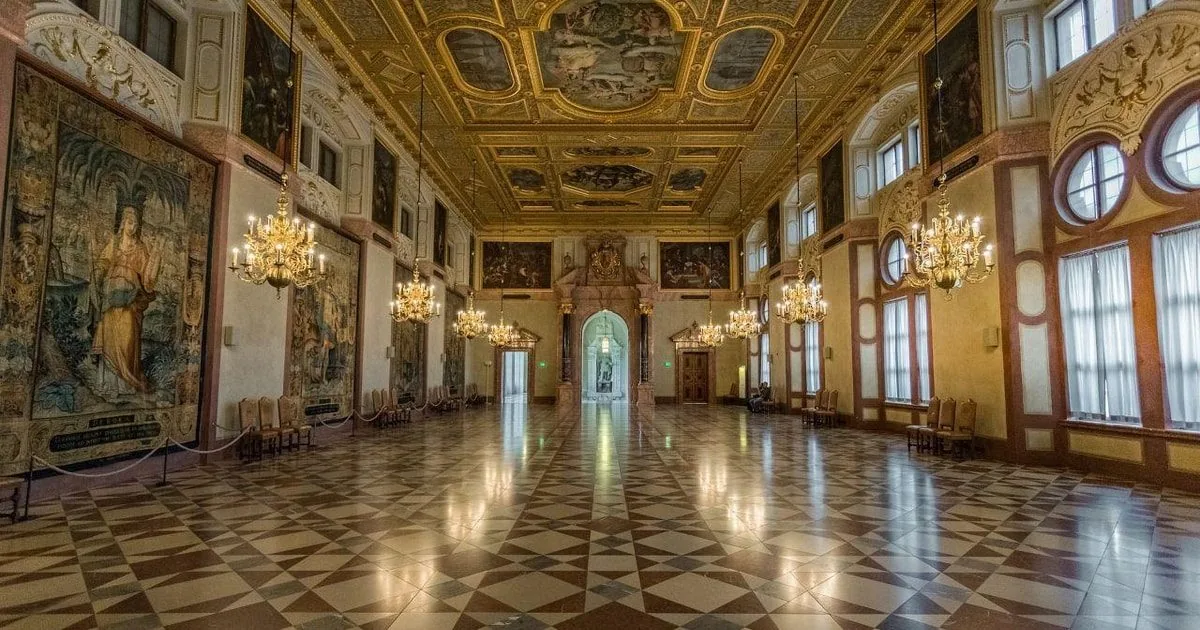
Every dynasty that stayed put long enough built one of these, and this is theirs: a long gilded gallery of forebears. It is worth standing in for a minute with the question that it exists to answer, which is not “who were these people” but “how long have we been here”. A gallery of ancestors is a claim of continuity, made in a building whose whole point was that the family did not have to leave the city to be grand.
The city’s own portal calls this the largest inner-city palace in Germany, and that phrase is the same claim in different words.
The one person here who never lived here
The most famous object in the Treasury belonged to somebody who came into this family from outside it and by arrangement. The Crown of Princess Blanche came to the Wittelsbachs in 1402 as the dowry of Blanche of England, daughter of Henry IV, on her marriage to Louis III, Elector Palatine; it has been kept in this treasury since 1782, it is described as the oldest surviving royal crown known to have been in England, and it probably belonged first to Anne of Bohemia, Richard II’s queen.
An object that travelled between courts as part of a marriage contract, and two women named in passing by the source that describes it. That is how a dynasty actually worked, and it is more informative about the people who lived here than another gilded ceiling (the crown, and the four things it is not).
What the Residenz was for
The concrete answer is that everything a court needed was inside one block: state rooms for receiving, a treasury for the regalia, a chapel, a theatre, and private apartments, all of it at one address in the middle of the city. The chapel and the theatre are both still used for music, which is why nearly three quarters of the written reviews for anything sold at this palace sit on concerts rather than on tours (the five concert listings).
That is also the difference between this palace and a country one. Nobody built the Residenz to get away from anything. It was built where the business was.
 Historian-led
Private Historian-Led Munich Residenz & Treasury Tour
 The guided one
Munich: Residenz Palace and Hofgarten Skip-the-Line Tour
 First review in
Munich Residence Tour: Historical Highlights & Storytelling
Follow the people into the rooms: Albrecht V’s hall, the treasure his will protected, the elector’s opera house, and the route that connects them.
Frequently asked questions
Who lived in the Munich Residenz?
The Wittelsbachs, the family that ruled Bavaria, who kept their main residence here in the middle of the city. The palace administration’s own pages name them room by room rather than as a chronology: Duke Albrecht V, who built the Antiquarium from 1568 to 1571; Wilhelm V and Maximilian I after him; Elector Maximilian Joseph III, who had the Cuvilliés Theatre built in 1751–55; and Ludwig I, whose royal apartment the city portal names.
What was the significance of the Residenz in Munich?
It put everything a court needed inside one city block: state rooms, a treasury for the regalia, a chapel, a theatre and private apartments. Munich’s own portal calls it the largest inner-city palace in Germany. What is on the route.
When did the Wittelsbachs stop living in the Munich Residenz?
The Residence Museum has been open to the public since 1920, which tells you the building had become a museum by then and nothing more exact. The Treasury reopened separately on 21 June 1958, after the war.
Who built the Munich Residenz?
No single person did, which is the point of the building. The parts visitors come for each have their own patron: the Antiquarium was built for Duke Albrecht V between 1568 and 1571, turned into a festival hall by Wilhelm V and Maximilian I between 1581 and 1600, and the Cuvilliés Theatre was built for Elector Maximilian Joseph III in 1751–55. The Antiquarium.
Whose crowns are in the Munich Residenz Treasury?
The Crown of the Kings of Bavaria and the Crown of the Queens of Bavaria, part of the insignia of the new kingdom that extended the Treasury to its full extent in the early 19th century. Also there is the Crown of Princess Blanche, which came to the Wittelsbachs in 1402 as an English dowry. The ten rooms.