The Cuvilliés Theatre: what survived, what did not, and why it opens at 2 pm
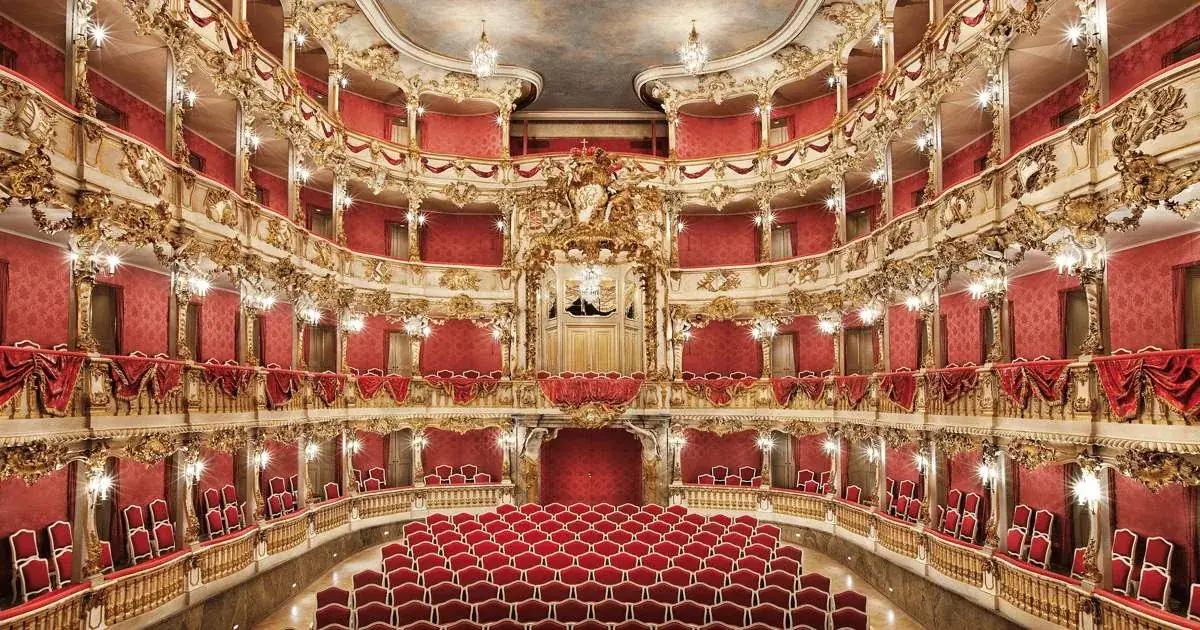
Four tiers of carved and gilded boxes, a court theatre built for an elector, and the room where Mozart’s Idomeneo was first performed in 1781. The palace administration calls it a major work of Bavarian Rococo, and it is the third of the three ticketed parts at this address: its own ticket at about five euros, its own entrance, and a timetable that catches more visitors than anything else here.
It is also a room with a wartime story, and that is the first thing to tell rather than the last.
What you are sitting in
The distinction here is not pedantry and the operator makes it itself. The building that housed the theatre was destroyed on 18 March 1944. The painted wood carvings and the other tier fittings were not in it: they had been removed to safety in 1943, and they are all that survives of the original theatre. In 1956 they were presented to the Bavarian Administration of State-owned Palaces, Gardens and Lakes, which restored them over the next two years and reassembled them in a new building inside the Residence complex.
So the carving is the theatre. The walls behind it are not. What you walk into is an eighteenth-century interior fitted into a twentieth-century shell, in a new building inside the same complex, and one thing that did not come through the war at all is Johann Baptist Zimmermann’s ceiling painting. Look up and what is missing is as much a part of the room as what is there.
My own view: a decision taken in 1943 to unscrew the carved woodwork of a rococo auditorium and cart it out of a city that was about to be bombed is the most interesting thing that ever happened in this room, and you are looking at the result of it.
Cuvilliés, Maximilian Joseph III and Idomeneo
It was built in 1751–55 by François Cuvilliés the Elder for Elector Maximilian Joseph III, as his new opera house. That is a court theatre in the strict sense: a private auditorium inside a private palace, built to a ruler’s order for a ruler’s guests, and the tiers of boxes are what that purpose looks like in wood.
Its claim on the wider world is one date: the first performances of Mozart’s Idomeneo, in 1781. If you have any interest in opera, that is what the room is for, and it is worth knowing that the carving in front of you was in place for it.
Why the 2 pm matters more here than anywhere else at this address
Every part of this palace has hours. Only this one has hours that differ from the rest of the building, and the difference is half a day. From Monday to Saturday it opens at 2 pm between 28 March and 31 July, between 15 September and 19 October, and through the winter from 20 October to 27 March. It opens in the morning on Sundays and public holidays, and daily between 1 August and 14 September.
The consequence is the most expensive small mistake at this address. Somebody buys the ticket that covers all three parts, at nine in the morning, on a Wednesday in November, because it is the ticket that sounds like the complete visit. They spend the morning in the museum and the Treasury, walk round to the theatre at one, and find a closed door with two hours to go. The pair ticket for the museum and the Treasury would have saved them the same amount and cost them nothing they could use (the two combined tickets, side by side).
| Cuvilliés Theatre | Monday to Saturday | Sundays and public holidays | Last entry |
|---|---|---|---|
| 28 March – 31 July | 2 pm – 6 pm | 9 am – 6 pm | 5 pm |
| 1 August – 14 September | 9 am – 6 pm | 9 am – 6 pm | 5 pm |
| 15 September – 19 October | 2 pm – 6 pm | 9 am – 6 pm | Not given in this row |
| 20 October – 27 March | 2 pm – 5 pm | 10 am – 5 pm | 4 pm |
| Closed on | 1 January, Shrove Tuesday, 24 December, 25 December and 31 December | The same five days | — |
Both timetables as published by the Bavarian Palace Administration for this address. Dates move; the desk is the authority on the day you are standing at it.
Visiting it in daylight, which takes minutes
A daytime visit is short: one room, and no audio guide in it — the handset covers the museum and the Treasury and stops there — so this is the room where a live guide adds most. Michael, who took a private tour that did not include the theatre and bought the ticket at the door afterwards, wrote that he and his party “visited it on our own (only took 5-10 minutes)”, and put the extra at about five euros, which is what the palace’s own tariff asks for that ticket.
That is not an argument against going in. It is an argument for going in last, on the way out, with no expectation that it will fill an hour. About five euros for ten minutes in a room like this is a fair trade.
What works
- A major work of Bavarian Rococo, by the operator’s own description
- Four tiers of carved boxes, in place for the first performances of Idomeneo in 1781
- Cheap on its own, and included in the ticket for all three parts
- Short, so it fits at the end of a day that has run long
- The one room at this address you can also be inside in the evening, at a concert
Worth knowing
- Not the original building: that was destroyed on 18 March 1944
- Zimmermann’s ceiling painting did not survive
- No audio guide, so this is the room where a live guide adds most
- Its own entrance — walk to the theatre door, not the museum’s
- Shut until 2 pm from Monday to Saturday for most of the year
The other way into this room
A daytime ticket buys you the room empty. The gala listing buys it in the evening with an ensemble on the stage, which is a different experience of the same carving and the only way to have it. It is an evening seat rather than a museum ticket, and its reviewers have the same question about the door as the daytime visitors do — Matthew Alan, on his first day in Munich, “did have some difficulty finding the entrance to the theater” (which entrance belongs to which part).
What is on the programme, what it costs and how the evening runs is on the concerts page, and a longer account is at the gala concert, reviewed.
 In the rococo theatre
Munich: Gala Concert in the Cuvilliés Theatre
 The guided one
Munich: Residenz Palace and Hofgarten Skip-the-Line Tour
 Private, all three parts
Munich: Residenz Palace, Museum and Treasury Private Tour
Also here: both timetables, which ticket covers this room, the museum route next door, and how the three parts divide an afternoon.
Frequently asked questions
Is the Cuvilliés Theatre original, or a reconstruction?
It is a reassembly, and the operator says so. The building housing the theatre was destroyed on 18 March 1944. The painted wood carvings and other tier fittings had been removed to safety in 1943 and are all that survives of the original; they were presented to the palace administration in 1956, restored over the next two years and reassembled in a new building inside the Residence complex. Johann Baptist Zimmermann’s ceiling painting is gone.
Why does the Cuvilliés Theatre open at 2 pm?
Because the palace administration publishes shorter hours for it than for the rest of the address. Monday to Saturday it opens at 2 pm from 28 March to 31 July, from 15 September to 19 October and from 20 October to 27 March. Mornings happen only on Sundays, on public holidays, and daily between 1 August and 14 September. Both timetables.
Who built the Cuvilliés Theatre?
François Cuvilliés the Elder, in 1751–55, for Elector Maximilian Joseph III as his new opera house. It is described by the operator as a major work of Bavarian Rococo, and it hosted the first performances of Mozart’s Idomeneo in 1781.
Is there an audio guide in the Cuvilliés Theatre?
No. The free audio guide runs in nine languages for the Residence Museum and the Treasury only; the theatre has no commentary at all — which is why the guided visit, whose inclusions name the theatre, is the way to have this room explained. What the handset does cover.
How long does the Cuvilliés Theatre take to visit?
Minutes rather than hours. It is one auditorium, there is no audio guide and there is nothing to walk round. One reviewer who visited it on his own after a tour that excluded it put his visit at five to ten minutes. Do it last rather than building an afternoon around it. How long the whole address takes.
Can you attend a concert in the Cuvilliés Theatre?
Yes, and it is the only way to be in that room in the evening. One listing in our catalogue is a gala concert there, running about two hours with an interval. It is a seat for an evening; the daytime rooms are the palace’s own ticket, or part of the guided visit. The five concerts and the halls they use.